When Insurance Starts Driving Cybersecurity Strategy
For many small and medium-sized businesses (SMBs), cybersecurity has historically been viewed as a back-office IT concern—important, but not mission-critical. That mindset is quickly changing.
Cyber insurance providers are now shaping how businesses structure and fund their security programs. What used to be optional controls—like endpoint detection, penetration testing, or 24/7 monitoring—are becoming non-negotiable requirements for obtaining or renewing cyber coverage.
This shift is forcing SMBs to rethink their Security Operations Center (SOC) strategy. Insurance companies are no longer simply writing policies—they’re setting the new standard for baseline cybersecurity. And in many cases, your ability to secure coverage (and lower premiums) depends directly on the maturity of your security posture.
So, what does this mean for your business?
Let’s explore how insurance-driven requirements are reshaping SOCs, what insurers now expect, and how Armour Cybersecurity can help you stay ahead of both threats and audits.
The Changing Landscape of Cyber Insurance
Cyber insurance was once relatively simple to acquire, with minimal requirements and broad coverage. But as ransomware attacks and data breaches surged, insurers were forced to re-evaluate their risk models. Claims skyrocketed. Losses followed. And in response, policies became harder to obtain—and more expensive.
Today, cyber insurance is conditional on proof that your business has implemented basic, effective cybersecurity controls. These may include:
- Multi-Factor Authentication (MFA)
- Endpoint Detection and Response (EDR)
- Employee Security Awareness Training
- Regular Penetration Testing
- A Documented Incident Response Plan
These requirements are no longer best practices—they’re table stakes. Businesses that don’t meet them risk higher premiums, limited coverage, or outright denial.
Your SOC Is Now a Line Item in Risk Assessment
The modern SOC isn’t just a monitoring hub—it’s an insurance qualification tool.
Insurers now ask detailed questions like:
- Do you have 24/7 visibility into your network and endpoints?
- Can you detect and contain a breach within hours?
- Is your alerting system tied to a formal incident response workflow?
- Are your controls regularly tested against real-world threats?
If the answer is no, your business may be viewed as high-risk—regardless of your size.
Fortunately, options like Managed Detection and Response (MDR) and SOC-as-a-Service mean SMBs can now access enterprise-grade protection without building internal security teams from scratch.
What Safeguards Are Insurers Requiring?
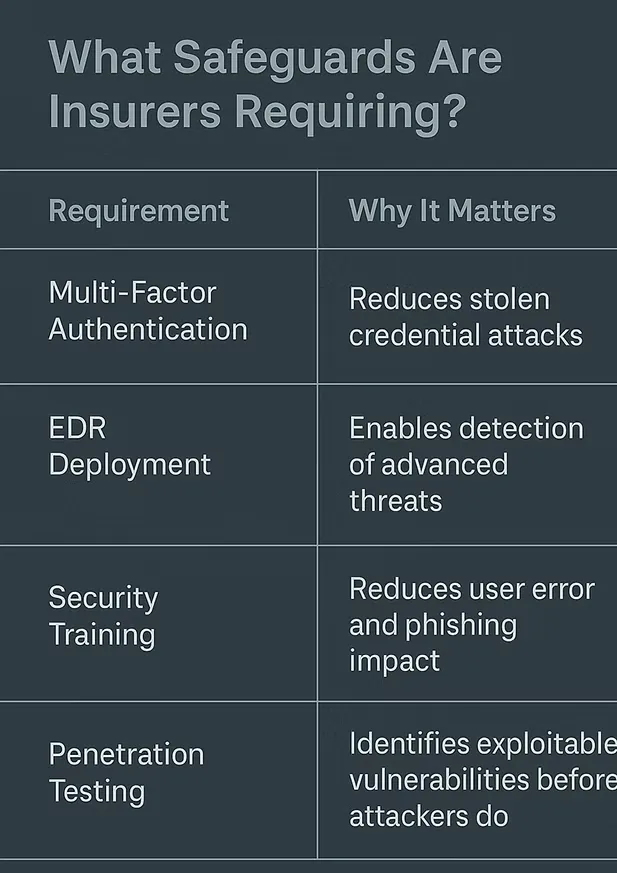
These controls are increasingly being used by underwriters to score your insurability. Businesses that can demonstrate these defenses are more likely to qualify for coverage, negotiate better terms, and avoid costly claim rejections.
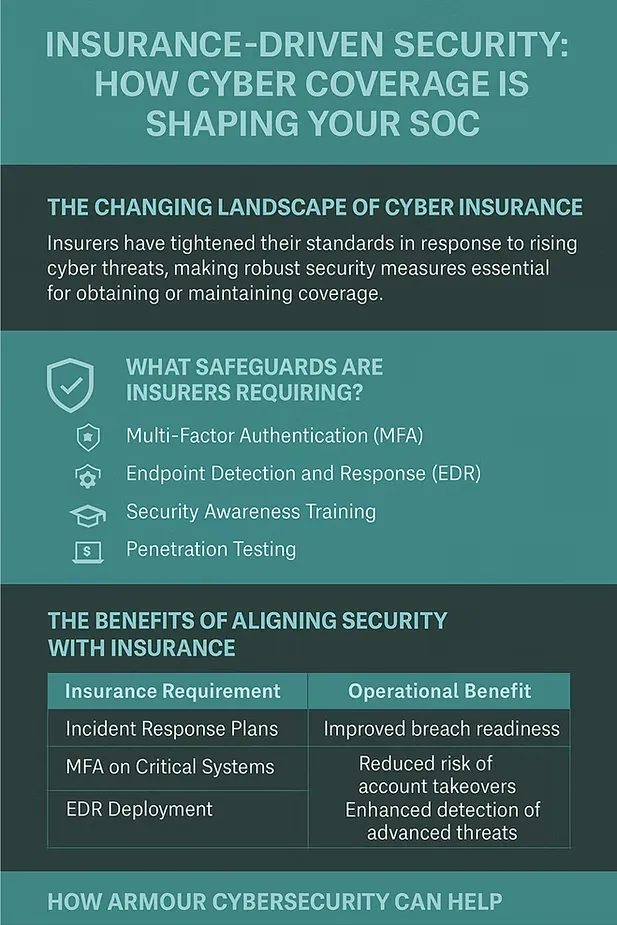
The Benefits of Aligning Security with Insurance
When done right, meeting insurance requirements has a powerful side effect: real security maturity.
| Insurance Requirement | Operational Benefit |
| Incident Response Plans | Faster and more coordinated breach recovery |
| MFA on Critical Systems | Fewer credential-based intrusions |
| EDR and 24/7 Monitoring | Rapid detection of stealthy or advanced attacks |
How Armour Cybersecurity Helps You Stay Insurable and Secure
At Armour Cybersecurity, we guide SMBs through the maze of cybersecurity insurance readiness with services that protect both your data—and your policy.
Here’s how we help:
SOC-as-a-Service: Enterprise-grade monitoring, detection, and response Cyber Insurance Readiness Assessments: Evaluate where you stand and close gaps MFA, EDR & Security Awareness Implementation: Meet insurer controls fast Incident Response Planning & Testing: Be ready, not reactive Ongoing Penetration Testing: Detect vulnerabilities before attackers do
We don’t just prepare you to pass an audit—we help you build resilience that insurers reward and attackers avoid.
Final Thoughts: Aligning Security and Insurance Is Smart Business
The cyber insurance landscape is no longer optional. It’s actively shaping how businesses implement cybersecurity, from budgets and tooling to staffing and reporting.
Instead of seeing it as a compliance headache, smart businesses are using insurance requirements as a framework for proactive protection, one that boosts both their defenses and their financial sustainability.
Ready to Strengthen Your Security and Secure Better Coverage?
Let’s make your business more resilient—on paper and in practice.
Reach out to Armour Cybersecurity today for a personalized consultation and find out how we can align your security with tomorrow’s insurance expectations.
Frequently Asked Questions (FAQs): Insurance-Driven Security for SMBs
1. Why is my insurance provider suddenly asking about cybersecurity controls?
Cyber insurers are reacting to a surge in claims related to ransomware, data breaches, and phishing. As losses increase, underwriters are tightening requirements to reduce risk exposure.
Controls like MFA, EDR, and employee awareness training are no longer optional—they’re required for policy approval or renewal.
2. What happens if my business doesn’t meet the requirements?
You could face:
- Higher premiums
- Reduced or denied coverage
- Claim rejections if you’re breached
Even worse, without these controls, your business is more vulnerable to actual attacks. Meeting insurer standards is both a compliance issue and a real-world defense.
3. What cybersecurity safeguards are insurers requiring in 2025?
While requirements vary by carrier, most expect:
- Multi-Factor Authentication (MFA)
- Endpoint Detection & Response (EDR)
- Security Awareness Training
- Regular Penetration Testing
- A Documented Incident Response Plan
These controls not only reduce your cyber risk—they also improve your chances of getting affordable, comprehensive coverage.
4. Do I need a full internal SOC team to qualify?
Not at all. Most SMBs today are turning to SOC-as-a-Service or Managed Detection and Response (MDR) providers.
These solutions deliver 24/7 monitoring, detection, and response—without the cost of hiring in-house analysts. Armour Cybersecurity provides fully managed services aligned with insurer requirements.
5. How can Armour Cybersecurity help us meet cyber insurance requirements?
We make insurance-readiness simple. Our services include:
- SOC-as-a-Service with 24/7 visibility
- EDR and MFA implementation
- Cyber Insurance Gap Assessments
- Penetration Testing
- IR Playbook Development
We help you meet insurer expectations and reduce real risk, all while scaling to your business’s size and needs.