
Cyber threats move fast. Your defenses have to move faster. From AI-driven analytics to cloud-native security and automated response, the tools we use to spot and stop attacks are evolving quickly. This guide breaks down the future trends in threat detection—and turns them into practical steps you can act on today.
From Signatures to Signals: Behavior Takes the Lead
Classic, signature-based tools are great at catching known malware—but attackers now mutate payloads and tradecraft faster than signature feeds can update. That’s why detection is shifting from what something is to what something does.
Behavior-based detection monitors process activity, command-line arguments, parent-child process trees, lateral movement paths, privilege escalations, and unusual data exfiltration patterns. When a behavior deviates from baseline (e.g., a finance workstation beaconing to an unfamiliar domain at 3 a.m.), modern tools score the risk and trigger a response, even if no signature exists.
Practical takeaways
- Build baselines per user, device, service account, and application—then alert on deviations, not just threats.
- Collect rich telemetry (EDR, NDR, identity logs, DNS, proxy, SaaS admin events) to reduce blind spots.
- Tune for precision: reduce alert fatigue by suppressing noisy but benign behaviors (e.g., known admin scripts).
AI & Machine Learning Make “Unknown” Attacks Detectable
AI/ML is no longer hype—it’s table stakes. Models trained on massive, diverse datasets can spot weak signals across endpoints, networks, identities, and cloud workloads. Expect to see:
- Anomaly detection at scale: Unsupervised models surface oddities that humans miss.
- Sequence-aware analytics: Models interpret chains of events (e.g., OAuth grant → mailbox rule change → API download spike).
- Adversarial-aware training: Defenders stress-test models against evasion techniques to harden them.
What good looks like
- Explainability: Analysts should see why the model flagged something (features, weights, peer comparisons).
- Continual learning: Feedback loops (true/false positive marking) refine models without full retrains.
- Model governance: Versioning, drift detection, and fairness checks to keep results trustworthy.
Predictive Analytics: Getting Ahead of the Blast
Predictive analytics uses historical patterns to forecast where risk is likely to materialize next. Think of it as risk weather: if exploit kits are trending for a new deserialization bug and you have unpatched Java apps exposed, the system raises your probability-of-incident score and pushes a preemptive control (WAF rule, VPC block, or forced patch window).
Use cases
- Vulnerability prioritization: Rank patches by exploitability and business exposure.
- Pre-crime alerts (within reason): Identify long dwell-time behaviors common in APTs and scan proactively.
- Capacity planning: Staff IR shifts when leading indicators spike (e.g., phishing campaigns targeting your industry).
Cloud-Native Detection: Built for Ephemeral Everything
The cloud changes the game: ephemeral workloads, service meshes, and serverless functions generate highly transient signals.
What to prioritize in the cloud
- Agentless + agent-based coverage: API-driven posture checks plus deep telemetry from critical hosts/containers.
- Micro-segmentation: Enforce least privilege east-west traffic; detect policy violations as signals of compromise.
- Identity-first detections: In cloud, identity is the new perimeter—monitor tokens, roles, and permission escalations.
- Container/K8s awareness: Watch for risky images, drift from signed manifests, and suspicious control plane changes.
Bonus: Cloud-native tools scale elastically and update continuously, so your detections keep pace with service changes without massive maintenance overhead.
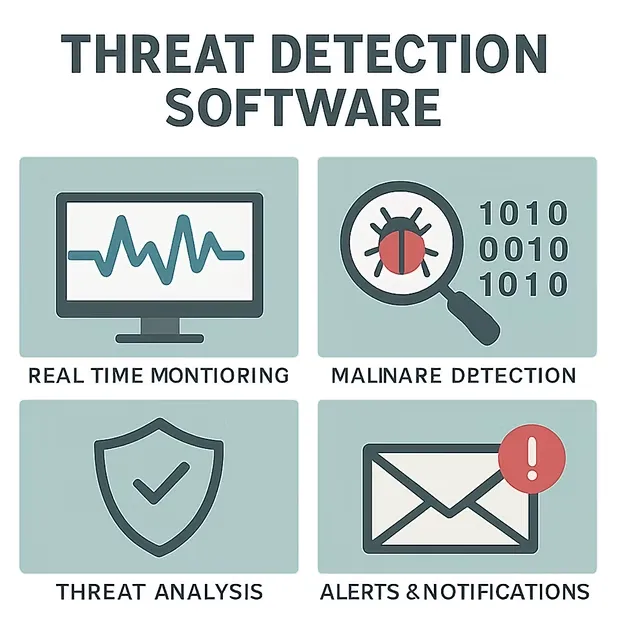
Threat Intelligence Gets Real-Time—and More Collaborative
Threat intelligence (TI) only helps if it’s relevant and timely. The next wave enriches detections with context you can act on immediately:
- Automated enrichment: As an alert fires, tools attach who is, passive DNS, malware family, TTPs, and related campaigns.
- Industry sharing (ISACs/ISAOs): Collaborative feeds add sector-specific signal (“this domain is hitting fintech login pages”).
- Indicator-to-TTP pivoting: Move beyond simple IOCs; correlate to MITRE ATT&CK techniques to guide the right response.
Tip: Organizations working with cybersecurity consulting partners should tune threat intelligence to their specific attack surface. Heavy SaaS? Weight identity and OAuth abuse intel. ICS/OT? Prioritize protocol anomalies and vendor advisories.
Automation Everywhere: SOAR, RPA, and Autonomous Response
Speed matters. Automation compresses the time between detection and containment:
- SOAR playbooks: If an endpoint attempts credential dumping, isolate the host, invalidate tokens, and open a case—automatically.
- Robotic Process Automation (RPA): Eliminate swivel-chair tasks (export logs, enrich artifacts, update tickets).
- Autonomous response (with guardrails): For low-risk actions (e.g., blocking a known C2 domain), allow one-click or auto-approval to act within seconds.
Governance must-haves
- Approval tiers by severity.
- Audit trails for every automated action.
- Sandboxes to simulate playbooks before production.
XDR: Unifying Endpoint, Network, Identity, Email, and Cloud
Extended Detection and Response (XDR) fuses telemetry across your stack, correlating signals that would be weak alone. Think of XDR as the storyteller that explains what happened, where, when, and what to do next.
Why it matters
- Higher fidelity: Correlating multiple weak signals into one strong incident reduces noise.
- Faster root cause: Built-in timelines and blast radius mapping focus your response.
- Simpler operations: One console beats five. (Just ensure it integrates with your existing SIEM/EDR/NDR.)
Zero Trust as a Detection Force Multiplier
Zero Trust isn’t just a network model; it’s a signal generator:
- Continuous verification: Every access request becomes a detection opportunity (impossible travel, device posture fails, anomalous scopes).
- Policy-as-code: Deny by default, log everything, and treat policy violations as high-signal events.
Metrics That Matter: Measure What Improves Resilience
To know if your detections are getting better, track:
- MTTD/MTTR: Mean time to detect/respond. Segment by incident type.
- Precision/recall: False-positive rate and missed detections from purple-team exercises.
- Coverage: % of critical assets with high-fidelity telemetry and enforced policies.
- Automation impact: % of incidents auto-contained and hours returned to analysts.
Buyer’s Checklist for Your Next Tool
- Coverage: Endpoints, cloud, identities, email, SaaS, OT (as needed).
- Integrations: SIEM, ticketing, EDR/NDR, IDP, MDM, firewalls, CSPM.
- Analytics: Explainable ML, correlation across domains, ATT&CK mapping.
- Response: Native isolations/blocks, SOAR, API-first.
- Ops: Role-based access, multi-tenant support, logs retention, compliance reports, and support for soc compliance initiatives.
- Cost clarity: Telemetry volume, data egress, storage tiers, add-on modules.
The Role of People: Training Turns Users into Sensors
Tools can’t fix culture. Ongoing, role-based training turns employees into early-warning sensors:
- All staff: Phishing simulations, password hygiene, reporting paths.
- Admins/engineers: Secure scripting, secrets handling, IaC scanning.
- Executives: Incident exercises, regulatory exposure, communication plans, and guidance from private security consulting experts.
Incentivize reporting (no-blame channels) and celebrate “near misses” caught by vigilant employees.
Compliance as a Catalyst, Not a Ceiling
Regulation (e.g., SOC 2, ISO 27001, GDPR, HIPAA, and soc compliance requirements) will continue to shape telemetry retention, data handling, and breach disclosure timelines. Treat compliance as minimum viable security—then go beyond with real-time detection, rapid containment, and tested response.
FAQs: Threat Detection, Answered
What’s the difference between EDR, NDR, SIEM, and XDR?
EDR watches endpoints; NDR watches network traffic; SIEM centralizes and searches logs; XDR correlates signals across all of the above to produce higher-fidelity detections and guided response.
How do I cut false positives without missing real threats?
Start with behavioral baselines, suppress recurring benign patterns, and adopt risk scoring that compounds weak signals. Run regular purple-team exercises to measure precision/recall, then tune rules and models.
Can small security teams benefit from AI/ML and automation?
Yes—prioritize a platform with opinionated detections out of the box and prebuilt playbooks for common incidents (phishing, malware, suspicious logins). Use automation for reversible actions (host quarantine, token revocation).
How do predictive analytics help in the real world?
They direct limited resources to where risk is rising—patch what’s exploitable, watch assets likely to be targeted, and staff on-call when early indicators (TI feeds, exploit chatter) surge.
What cloud-specific detections should I enable first?
Focus on identity (privilege escalations, risky OAuth grants), data exfiltration (S3 bucket policy changes, egress anomalies), and control-plane monitoring (new keys, policy edits, KMS usage spikes).
Is Zero Trust realistic for legacy environments?
Adopt it incrementally: enforce MFA and device health, add network micro-segmentation around critical apps, and move to policy-as-code for new services while you ring-fence older ones.
How should I measure detection program success?
Track MTTD/MTTR, false-positive rate, coverage of critical assets, and the percentage of incidents auto-contained. Tie metrics to business risk (e.g., reduced downtime or data loss).