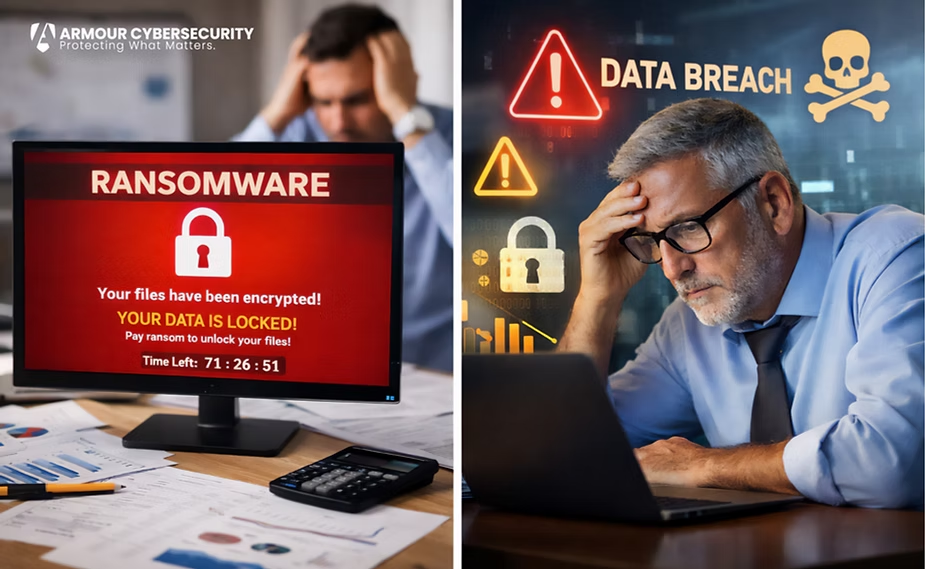
It is 8:07 a.m. on a Monday in March, right in the middle of tax season.
Staff begin logging into their systems, but something is wrong. Files will not open. The accounting software is frozen. Email access is inconsistent.
Then someone notices a message on their screen.
Your files have been encrypted. To regain access, follow these instructions.
Within minutes, the managing partner’s phone starts ringing.
Clients are calling.
Payroll files cannot be accessed. Corporate tax returns are mid process. Deadlines are approaching. The IT provider is investigating, but there are no clear answers yet.
This scenario is not rare. It is happening to accounting firms across North America, including both the United States and Canada. Many of those firms believed they were too small to be targeted.
They were wrong.
Why Accounting Firms Are Prime Targets for Cyberattacks
Accounting firms hold one of the most concentrated collections of sensitive financial information in the private sector.
In a single system, attackers may find Social Security numbers, Social Insurance Numbers, tax returns, Employer Identification Numbers, bank account information, payroll records, and detailed corporate financial statements.
To a cybercriminal, breaching an accounting firm provides access to hundreds of businesses and individuals at once.
Small and mid sized firms are especially attractive because they manage highly valuable data but often lack dedicated cybersecurity teams. Attackers are not searching for the largest firm.
They are searching for the most accessible one.
This is why cybersecurity for accounting firms is no longer optional. It is a fundamental business requirement.
The Real Cost of a Cyberattack
When leadership thinks about cybersecurity, it is often viewed as a technology issue. In reality, it is a financial and reputational event.
The immediate costs can include digital forensics investigations, legal counsel, client notification requirements, credit monitoring services, public relations management, and in some cases ransom payments.
Operational disruption may be even more damaging.
What happens if your firm cannot access client data for five days during tax season. What if payroll processing is interrupted. What if staff cannot retrieve financial records needed for filings.
Regulatory obligations also come into play.
In the United States, accounting firms must meet IRS safeguard requirements and comply with the FTC Safeguards Rule. In Canada, firms handling taxpayer data must comply with Canada Revenue Agency safeguard expectations as well as federal and provincial privacy laws.
Failure to demonstrate reasonable data protection measures can result in penalties, investigations, lawsuits, and long term reputational damage.
Trust is the foundation of every accounting relationship. A data breach can weaken that trust overnight.
The Cyber Insurance Misconception
Many firms feel protected because they carry cyber insurance.
Insurance is important, but it is not a cybersecurity strategy.
Modern cyber insurance policies often require multi factor authentication, endpoint detection and response, formal patch management, employee security awareness training, and
properly secured and tested backups.
If required safeguards are not in place, claims can be reduced or denied.
Even when coverage applies, insurance does not restore client confidence. It does not prevent reputational harm. It does not eliminate the stress and uncertainty leadership faces during a crisis.
Insurance absorbs some financial impact. It does not prevent the event.
The Expanded Risk of Hybrid Work
The modern accounting firm operates in a hybrid environment. Employees access systems from home offices, shared workspaces, and mobile devices.
Each remote connection expands the firm’s risk exposure.
A weak home Wi Fi network. A successful phishing email. A misconfigured cloud storage account.
These small vulnerabilities can become entry points for major breaches.
Your security perimeter is no longer limited to your physical office. It extends to every location where your employees log in.
Cybersecurity Is Now a Leadership Responsibility
Cyber risk directly affects revenue continuity, regulatory compliance, insurance eligibility, and client retention.
It is no longer something that can be delegated entirely to IT.
Managing partners and CEOs should be able to answer several critical questions with confidence.
Could we restore operations within seventy two hours after a ransomware attackWhen was our last independent security assessmentAre our backups tested and protected against tamperingDo we have a documented and practiced incident response planWho at the
executive level is accountable for cyber risk
If these questions cannot be answered clearly, the risk is already present.
The Firms That Will Lead the Industry
Cyber threats are not slowing down. They are becoming more automated and more financially motivated.
However, firms that approach cybersecurity as an operational safeguard position themselves differently.
They invest in layered protection. They train their employees. They regularly test their systems. They align cybersecurity with IRS and CRA compliance expectations. They treat data protection as part of their fiduciary duty to clients.
Clients are increasingly asking about cybersecurity posture before signing engagement agreements. Larger organizations often require documented safeguards before sharing financial information.
Cybersecurity is becoming not only a protective measure but also a competitive advantage.
A Final Reflection for Firm Leaders
Every accounting firm is built on trust.
Clients trust you with their identities, their finances, and the details that define their businesses.
Protecting that information is no longer just a technical obligation. It is a leadership responsibility.
The question is not whether accounting firms are targets for cyberattacks.
They are.
The question is whether your firm is prepared, or whether the first serious conversation about cybersecurity will happen at 8:07 a.m. on a Monday in March.