How Often Should Your Business Get a Penetration Test?
Aug 20, 2026
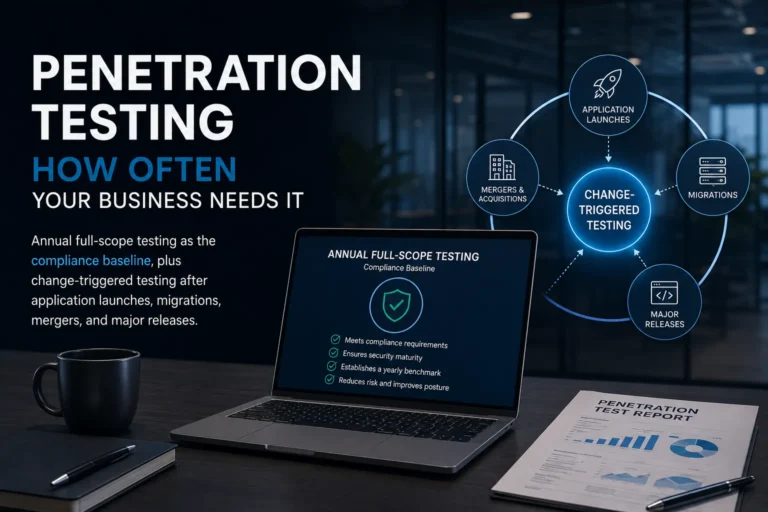
How often penetration testing a business needs starts with the annual baseline that PCI DSS, SOC 2, ISO 27001, and HIPAA expect....


Penetration testing is a controlled, manual security assessment in which certified ethical hackers simulate real-world attacks against your systems to find and safely exploit vulnerabilities before criminals do — using human expertise to chain weaknesses together, confirm what is actually exploitable, and deliver prioritized, remediation-ready findings.
Automated scanners find the easy issues. Real attackers find the chained vulnerabilities that scanners miss. Armour Cybersecurity's penetration testing team conducts manual, hands-on testing across networks, applications, cloud infrastructure, and the human attack surface, delivering findings written for executives and detailed remediation guidance written for engineers.
A penetration test is an authorized simulated attack against your systems, applications, and people, conducted to identify exploitable vulnerabilities the way a real adversary would find them. The point is not to run a scanner and hand you the report. The point is to think like an attacker, chain the findings together, and demonstrate the actual impact a determined adversary could achieve in your environment.
Our consultants are OSCP-certified and bring offensive security experience from intelligence and Big Four backgrounds. Engagements are conducted against documented methodologies including PTES (Penetration Testing Execution Standard), OWASP Testing Guide for application work, and NIST 800-115 for technical security testing. Findings are reproducible, ranked by real exploitability, and delivered with remediation guidance your engineers can actually act on.
Every engagement is scoped collaboratively. We agree the targets, the rules of engagement, the testing windows, and the escalation procedures before any testing begins. The output is a clear picture of your real exposure and a prioritized path to closing the gaps that matter most.
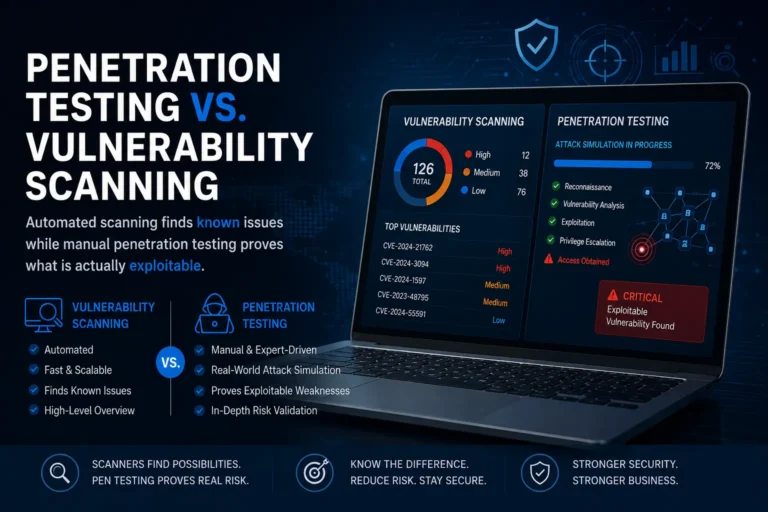
Automated vulnerability scanners are useful for surface-level hygiene but cannot replicate how real adversaries operate. They miss chained vulnerabilities, business logic flaws, and the creative paths attackers actually use to reach what matters.
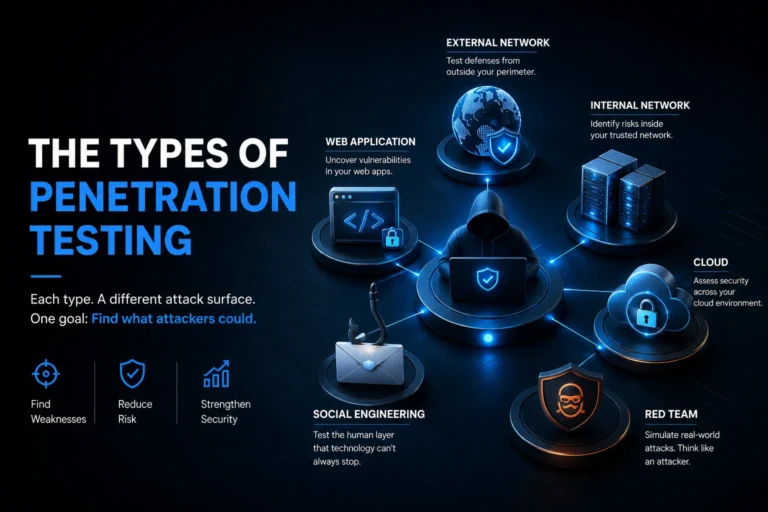
Engage individual test types or coordinated multi-vector engagements. Every test is scoped collaboratively and conducted under documented rules of engagement.
Adversarial testing of internet-facing systems, services, and infrastructure. Identifies the vulnerabilities and exposures a remote attacker would discover and exploit.
Assumed-breach testing from inside the network simulating a compromised endpoint or rogue insider. Tests segmentation, lateral movement potential, and privilege escalation paths.
Manual application testing aligned to OWASP methodology covering authentication, authorization, business logic, injection, session management, and modern application-specific vulnerabilities.
iOS and Android application testing covering binary analysis, runtime testing, API exposure, transport security, and mobile-specific vulnerabilities including jailbreak and root detection.
AWS, Azure, and Google Cloud testing covering identity and access management, configuration drift, exposed services, and lateral movement potential across cloud and hybrid environments.
Targeted phishing campaigns, vishing, and physical social engineering scoped to test the human attack surface. Designed to measure awareness and improve resilience, not to embarrass employees.
Multi-vector adversarial engagements simulating advanced persistent threat scenarios. Goal-oriented testing that measures detection and response capability, not just vulnerability presence.
Manual testing of REST, GraphQL, and gRPC APIs covering authentication, authorization, input validation, business logic, and API-specific issues including BOLA, BFLA, and excessive data exposure.
Collaborative engagements pairing our offensive team with your defensive team. Designed to improve detection, response, and threat-hunting capability through guided live-fire exercises.
Penetration testing is a common requirement for SOC 2, ISO 27001, PCI DSS, and HIPAA. Our reports are structured for direct use during the formal audit engagement.
Enterprise customers and regulators frequently require independent penetration testing as part of vendor security assessments or ongoing compliance obligations.
Application launches, infrastructure migrations, and major architecture changes are inflection points where new vulnerabilities are introduced. Testing before exposure prevents costly remediation later.
Organizations with established security programs that want to validate detection and response capability through purple team or red team engagements rather than checkbox testing.
Every Armour Cybersecurity penetration testing engagement follows the same standardized phases. The discipline is what makes findings reproducible and remediation actionable.
Define targets, methodology, testing windows, escalation procedures, and authorized testing boundaries. Documented rules of engagement signed before any testing begins.
Open-source intelligence gathering, infrastructure discovery, and service enumeration to map the attack surface the way an external adversary would.
Combination of automated scanning and manual analysis to identify potential vulnerabilities. Manual validation removes false positives before exploitation begins.
Hands-on exploitation of identified vulnerabilities, chained where possible to demonstrate real impact. Conducted within agreed rules of engagement and escalation procedures.
Evaluate the actual business impact reachable from successful exploitation. Document the path an attacker would take and the assets they could reach.
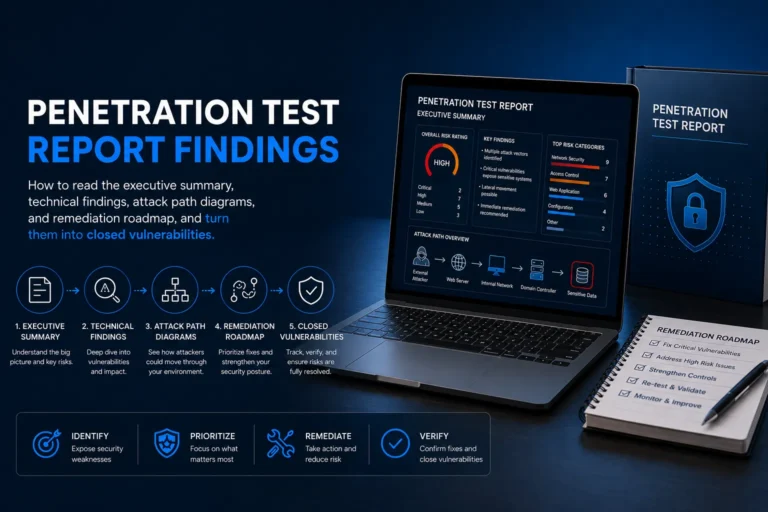
Executive summary, technical findings with reproduction steps, ranked remediation guidance, and a remediation briefing with your engineering team to walk through every finding.
Every deliverable is structured for direct use by executives, engineers, and external auditors when applicable.
Board-ready narrative covering test scope, key findings, business impact, and prioritized remediation focus areas in non-technical language.
Each finding documented with severity, exploitability, reproduction steps, evidence, and clear remediation guidance for engineering teams.
Visual documentation of chained vulnerabilities showing how an attacker would move through your environment from initial access to objective.
Prioritized remediation plan ranked by real exploitability and business impact, with effort estimation for each finding.
Detailed documentation of the testing methodology, scope, rules of engagement, and standards applied during the engagement.
Findings mapped to SOC 2, ISO 27001, PCI DSS, HIPAA, and other applicable framework requirements for direct use during audits.
Screenshots, payloads, and proof-of-concept evidence allowing your engineering team to reproduce and verify each finding independently.
Live walk-through of every finding with your engineering team. Q&A, clarification, and remediation guidance delivered directly rather than left to a report.
Optional follow-up engagement to validate that remediation has successfully closed identified findings before subsequent audits or production releases.
What organizations typically invest by test type, based on 2026 US market data. Final pricing depends on scope, environment size, and compliance requirements.
| Test type | What it covers | Typical US cost (2026) |
|---|---|---|
| External network | Internet-facing assets — firewalls, VPNs, email gateways, public web servers | $4,000 – $15,000 |
| Web application | OWASP Top 10, authentication flaws, business-logic vulnerabilities | $5,000 – $30,000 |
| API | Authentication, authorization, and API-specific vulnerabilities | $5,000 – $20,000 |
| Mobile application | iOS / Android application security testing | $5,000 – $30,000 |
| Cloud / SaaS | Cloud configuration, multi-tenant SaaS, M365 / Azure / AWS / GCP | $5,000 – $35,000 |
| Full red team / complex | Multi-vector, objective-based engagements; IoT; product security | $50,000 – $150,000 |
US market, 2026. The average penetration test runs about $18,300; qualified testers typically bill $200–$350 per hour. Figures are market context to help with budgeting — request a scoped quote for pricing specific to your environment.
Founded by military intelligence veterans with senior advisors from PwC, KPMG, Deloitte, EY, and Mandiant. The track record reflects the discipline.
Organizations across finance, healthcare, technology, energy, legal, and government trust Armour Cybersecurity to protect what matters.
Long-term engagements built on consistent quality, predictable delivery, and consulting relationships that compound in value over time.
Cross-sector experience spanning every major regulated industry, with operations supporting clients across North America, Latin America, and beyond.
A vetted catalogue of technology partnerships and proprietary methods deployed in support of every engagement.
Schedule a no-obligation penetration testing scoping conversation.
Schedule a Penetration TestTell us about the systems, applications, or scenarios you want tested. We will respond within one business day with next steps.