
Shift Left or Get Left Behind: Why DevSecOps Is No Longer Optional
The Invisible Breach Starts Before You Even Launch
Attackers no longer wait for your code to go live; they strike in the shadows of development, long before launch. While businesses race to innovate, threat actors are infiltrating the build process itself. They exploit misconfigured APIs that expose sensitive data, inject malicious code through open-source libraries, and quietly harvest hardcoded secrets left behind in public GitHub repositories.
They don’t need to break in; they simply wait for your developers to leave the door open.
Meanwhile, traditional security models are stuck in a reactive loop—testing late, patching slower, and missing the stealthiest threats entirely. What was once a secure perimeter is now scattered across containers, pipelines, and cloud workloads.
This is the new battleground.
DevSecOps isn’t a buzzword. For SMBs, it’s the only thing standing between rapid growth and rapid exploitation.
What Is DevSecOps?
DevSecOps is short for Development, Security, and Operations — a methodology that bakes security into every phase of your software lifecycle, from design to deployment. It shifts security left, embedding controls and validation early when vulnerabilities are cheaper to fix and more complicated to miss.Organizations increasingly adopt devsecops services to ensure security controls are integrated directly into development workflows rather than being treated as a final checkpoint.
For SMBs without large security teams, it’s not about building a fortress. It’s about keeping people from the start. That’s exactly what purpose-built DevSecOps services are designed to deliver — giving smaller teams access to the tooling, pipeline integration, and expertise needed to embed security without hiring a full in-house practice. Many organizations also leverage cybersecurity consulting services to align development workflows, security controls, and compliance requirements from the earliest stages of software delivery.
Why DevSecOps Matters More for SMBs
Big enterprises have red teams, 24/7 SOCs, and endless tooling. You don’t.
You have:
- Agile teams with tight deadlines
- Limited IT staff wearing multiple hats
- Budget constraints that delay security projects
- Fast-moving developers using open-source and AI-generated code
That’s exactly what attackers love. They thrive in speed, gaps, and assumptions. SMBs are now their favourite targets — not because you’re careless, but because you’re exposed. For many growing organizations, combining DevSecOps practices with broader cybersecurity services for small business helps reduce security gaps while maintaining development speed.
By embedding DevSecOps into your dev cycles, you reduce:
- Attack surface area before it reaches production
- Manual errors like exposed secrets and misconfigured access
- Time to detection by automating testing and scanning
- Vendor and toolchain risk by enforcing policies across your stack
The Cost of Waiting
Let’s be clear: shifting left isn’t just about compliance or best practices. It’s about survival. Many organizations first uncover development-related security weaknesses during a formal cybersecurity risk assessment, often discovering issues that could have been prevented earlier in the software lifecycle.
A single exploited vulnerability can mean:
- Lost customer trust
- Delayed product releases
- Regulatory fines
- Ransom demands or data theft
- Increased insurance premiums or denied claims
SMBs often think, “We’re too small to be targeted.” That’s not true anymore. In fact, smaller businesses often lack the detection and response maturity to know they’ve even been compromised.
DevSecOps in Action (for SMBs)
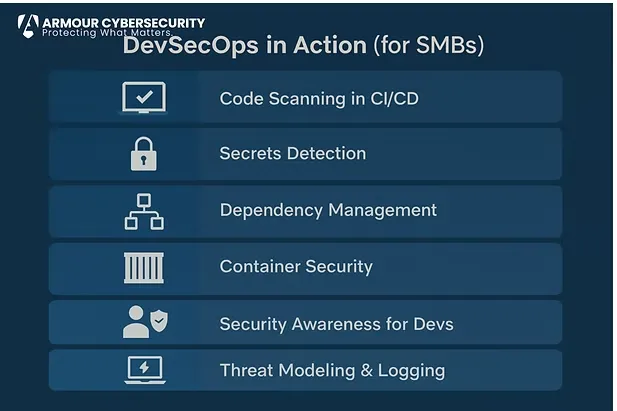
Here’s what a basic, real-world DevSecOps strategy looks like for a growing business:
- Code Scanning in CI/CD Automatically scan for vulnerabilities and misconfigurations during code commits and build stages.
- Secrets Detection Prevent developers from pushing passwords, API keys, or tokens to public or private repos.
- Monitor third-party libraries for known CVEs and outdated components. This capability is often included within mature application security manager programs to help development teams maintain visibility across software dependencies and emerging vulnerabilities.
- Container Security Use hardened images and scan for vulnerabilities before deployment.
- Role-Based Access & MFA Enforce access policies across dev and production systems.
- Security awareness training for developers Train your dev team on secure coding, secure AI use, and least-privilege principles.
- Threat Modelling & Logging Even a lightweight model helps forecast how attacks may unfold — and logging gives you the evidence to respond fast. These practices also strengthen incident response planning by helping teams detect, investigate, and contain security events more effectively.
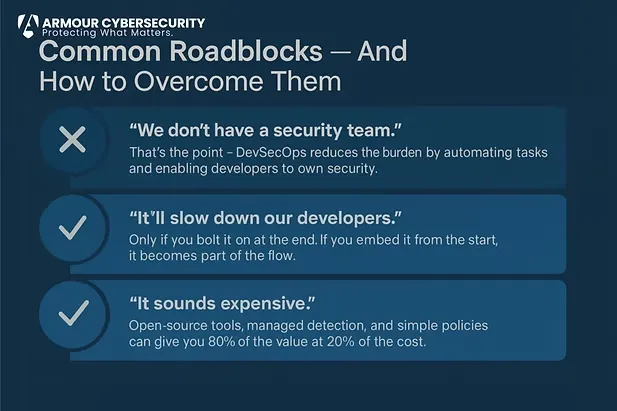
The MSSP Advantage
You don’t have to do this alone. A Managed Security Services Provider (MSSP) can support organizations through managed cybersecurity services, helping teams integrate security controls into development pipelines while continuously monitoring for emerging threats.
- Implement DevSecOps tooling for your specific stack
- Monitor for threats across your pipeline and cloud environment
- Ensure code quality, access control, and policy enforcement
- Keep you audit-ready through strong governance risk and compliance practices.
We help small and medium businesses secure what they build before attackers exploit what they miss.
Final Thought: Shift Left, or Risk Being Left Behind
Speed wins in business. But in security, speed without visibility invites disaster. Many organizations pair DevSecOps initiatives with ongoing cybersecurity consulting services to continuously improve development security, governance, and operational resilience as their environments evolve.
DevSecOps isn’t just for the enterprise. It’s for everyone trying to grow fast — and grow safely, starting with a cybersecurity posture assessment that identifies security gaps before they reach production.
Frequently Asked Questions (FAQs)
Q: How does DevSecOps reduce the risk of production incidents?
A: By identifying misconfigurations and vulnerabilities earlier, DevSecOps reduces the likelihood of last-minute fixes, emergency patches, and security incidents in production.
Q: What cultural challenges commonly slow DevSecOps adoption?
A: Resistance often comes from fear of added workload, lack of security awareness, or unclear ownership. Leadership alignment and training are critical to overcoming these barriers.
Q: What metrics should organizations track to measure DevSecOps success?
A: Metrics may include vulnerability remediation time, security defect escape rates, deployment frequency, and the number of issues detected earlier in the development lifecycle.