Why SMBs Can’t Afford to Ignore EDR
Cybercrime has become the great equalizer. Hackers are no longer targeting only Fortune 500 giants; small and medium-sized businesses (SMBs) have become the primary targets. The reality is chilling: many SMBs never recover from a serious cyberattack, with a large percentage shutting down within just months of the incident.
Why? Unlike large enterprises, SMBs often lack the budget, in-house expertise, and layered defences needed to withstand a modern breach. That makes them easier prey. And the financial fallout is brutal. IBM found that the average cost of a data breach hit $4.88 million in 2024 (IBM Security Report). Even a fraction of that number can cripple, or outright end, a growing business.
This is where Endpoint Detection and Response (EDR) steps in, not as a nice-to-have, but as a survival tool.
The Evolution of Endpoint Security
To understand why EDR is critical, it helps to know where endpoint security came from:
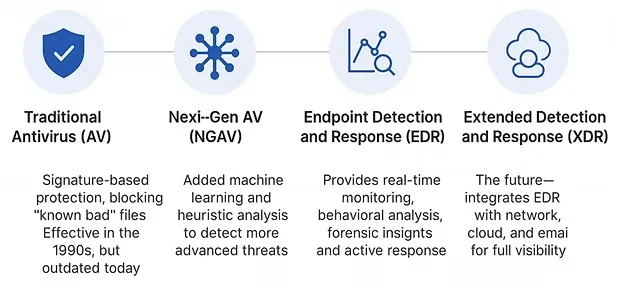
This evolution reflects one truth: threats keep advancing, so defences must evolve too.
How EDR Works: Step by Step
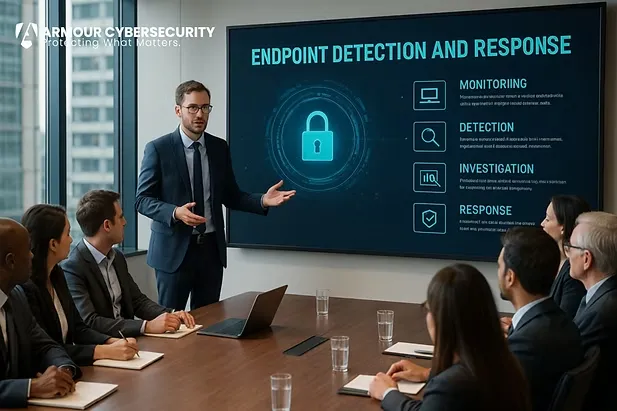
EDR protects endpoints (laptops, desktops, servers) by continuously monitoring and responding. The process typically follows four stages:
- Monitoring: Constant data collection from endpoints (processes, file activity, logins, network connections) and integration with other network security tools for broader visibility..
- Detection: Identifying abnormal behaviours, e.g., mass file encryption (ransomware) or unusual PowerShell execution.
- Investigation: Providing root-cause analysis and attack chain visualization to understand what happened.
- Response: Isolating compromised machines, terminating malicious processes, and sometimes even rolling back changes.
This lifecycle turns EDR into both a detective and a firefighter. Catching threats early and extinguishing them before they spread.
The ROI of EDR: Prevention Pays
Cybersecurity investments often face budget pushback. But EDR’s return on investment is compelling:
- Average global cost of a breach: $4.88 million (IBM, 2024).
- Average savings with advanced security tools (like EDR): $1.9 million per breach (IBM, 2024).
For SMBs, the math is simple: preventing even a single incident justifies the cost of EDR many times over.
Beyond direct savings, EDR reduces downtime, preserves customer trust, and avoids regulatory fines, all of which impact long-term revenue.
Real-World Scenarios: How EDR Saves SMBs
Scenario 1: Ransomware Stopped in Its Tracks
An employee clicks a phishing link that initiates a ransomware attack by silently accessing shared network files. Traditional antivirus tools often miss stealthy threats like these. However, EDR can detect unusual file activity—such as mass encryption—and take immediate action to isolate the infected endpoint, thereby preventing the ransomware from spreading across the network. This containment can save businesses from catastrophic data loss and significant financial damage.
Supporting source: Cisco explains EDR’s ability to isolate compromised endpoints and stop encryption propagation. (Cisco)
Scenario 2: Insider Data Theft Detected Early
Imagine a disgruntled employee trying to copy sensitive files onto a USB drive. While traditional security tools may overlook such insider activity, EDR monitors for anomalous behaviour, such as unusual file transfers, and can trigger alerts or block the action before data leaves the organization. This proactive detection helps avoid regulatory fines and safeguards your company’s reputation.
Summary Table
| Scenario | Threat Type | EDR Capability | Real Benefit | Source Reference |
| Ransomware outbreak | External malware | Detects encryption behaviour | Stops spread, avoids data loss | Cisco on isolation (Cisco, fortinet.com, arxiv.org) |
| Insider data exfiltration | Internal misuse | Flags abnormal file transfers | Prevents data theft/reputation loss | Behaviour-based detection (SolCyber) |
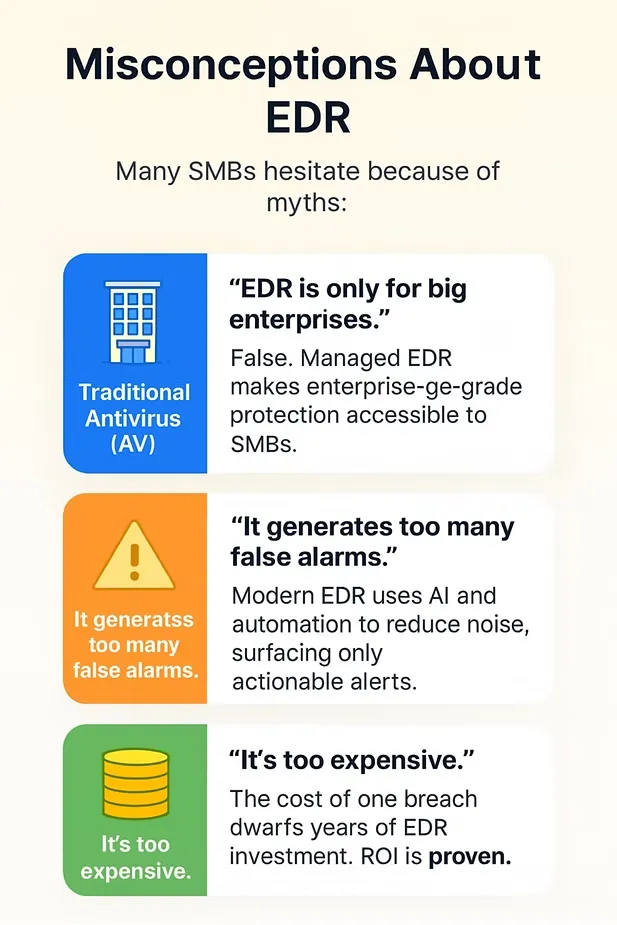
Misconceptions About EDR
Many SMBs hesitate because of myths:
EDR vs. MDR vs. XDR
Cybersecurity acronyms can be confusing. Here’s the difference:
- EDR → Focuses on endpoint protection, monitoring, and response.
- MDR (Managed Detection and Response) → Outsourced experts manage EDR and monitor threats 24/7. Ideal for SMBs and a core component of modern cybersecurity services for small business.
- XDR (Extended Detection and Response) → Combines endpoint, network, email, and cloud visibility into one system while correlating data from multiple network security tools.
For most SMBs, MDR is the sweet spot—strong protection without hiring a whole security team or relying solely on an internal IT department, making it a practical solution from a cybersecurity services provider.
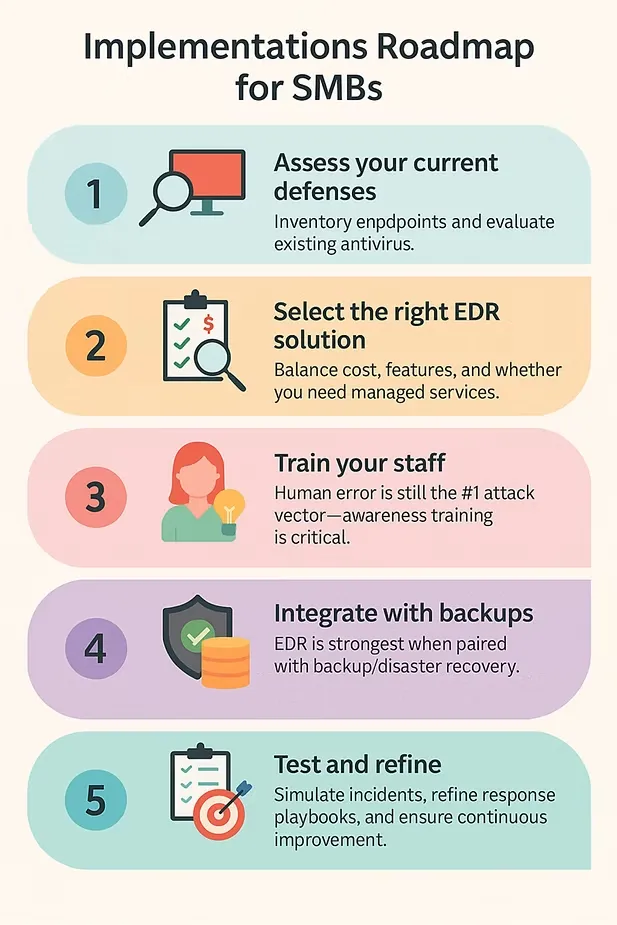
Implementation Roadmap for SMBs
Ready to get started? Here’s a practical roadmap:
The Future of EDR
EDR is not standing still. Expect to see:
- More AI-driven detection: Catching even subtle anomalies.
- Cloud-based EDR: Easier deployment and scalability.
- Integration into Zero Trust frameworks: Ensuring “never trust, always verify” security.
- Evolution toward XDR: Unified visibility across all attack surfaces.
For SMBs, this means that EDR will become increasingly accessible, smarter, and more essential.
Conclusion: EDR as an SMB Game-Changer
EDR is no longer an enterprise-only tool—it’s a lifeline for SMBs facing modern cyber threats and an important part of comprehensive cybersecurity services for small business.
It protects endpoints, delivers measurable ROI, supports compliance, and ensures continuity in a threat landscape that punishes the unprepared.
In a world where a single breach can close your business, EDR isn’t optional. It’s your shield, your insurance, and your pathway to resilience.
The real question isn’t if you need EDR—it’s whether you can afford to go without it.
Frequently Asked Questions (FAQ)
Q1. Isn’t EDR just antivirus with a new name?
No. Antivirus blocks known threats, but EDR goes further by spotting unusual behaviours, investigating automatically, and containing threats before they spread.
Q2. Why would hackers target small businesses?
Attackers are aware that SMBs often lack full-time security teams. They target the “low-hanging fruit,” making SMBs just as likely, if not more so, to be targeted as big corporations.
Q3. Will EDR drain my IT resources?
Not if it’s implemented properly. Many solutions offer dashboards and automation that reduce manual work, allowing IT staff to focus on higher-value tasks.
Q4. Can EDR really save me money?
Yes. The cost of a single breach — including downtime, recovery, and lost clients — can easily